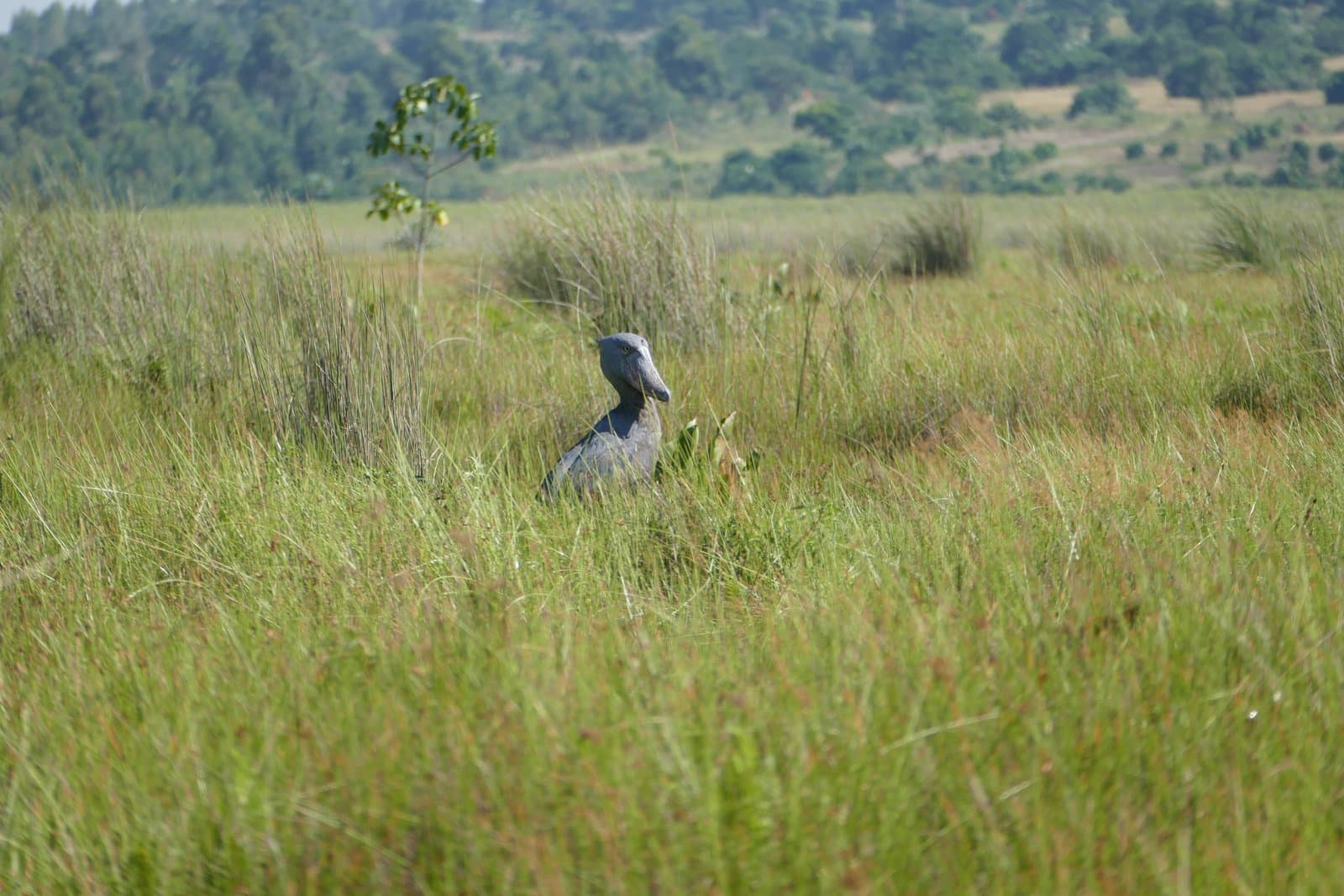
Reference photo, not taken by the Centre — Sjoerdug, CC BY-SA 4.0, via Wikimedia Commons.
The shoebill (Balaeniceps rex) is not a bird you forget once you've seen one. Nearly a metre and a half tall, with a bill shaped — as the name suggests — like an upturned wooden clog, it stands motionless in papyrus swamps for long stretches, waiting for lungfish and other prey to surface. Uganda's wetlands, including areas not far from our own region, are among the most reliable places left on Earth to find one.
That's precisely why it matters as a conservation subject. The shoebill can't survive outside intact wetlands — it needs the specific mix of slow water, dense papyrus, and abundant fish that a healthy swamp provides. Wherever a shoebill can still be found, the wetland underneath it is doing real ecological work: filtering water, buffering floods, and supporting fish stocks that local communities depend on too. Losing the bird would mean losing all of that first.
This is the case we make to the young people who come through our conservation education sessions: you don't have to love birds to have a reason to protect wetlands, but a bird this distinctive makes the reason easy to remember. Teaching a name and a silhouette is the easy part. Teaching why an out-of-the-way swamp is worth leaving alone — when there's pressure to drain it, farm it, or build on it — is the actual goal.
We want to be clear about what this programme is and isn't. We run conservation education and awareness sessions. We do not operate a sanctuary, conduct scientific research, or manage a protected wetland ourselves. What we can do is make sure the next generation in our parish understands what's at stake in the wetlands around them, long before any of them are in a position to decide what happens to that land.
Interested in supporting this work?
Get involved